The "How" Core Engineering & Security Architecture.
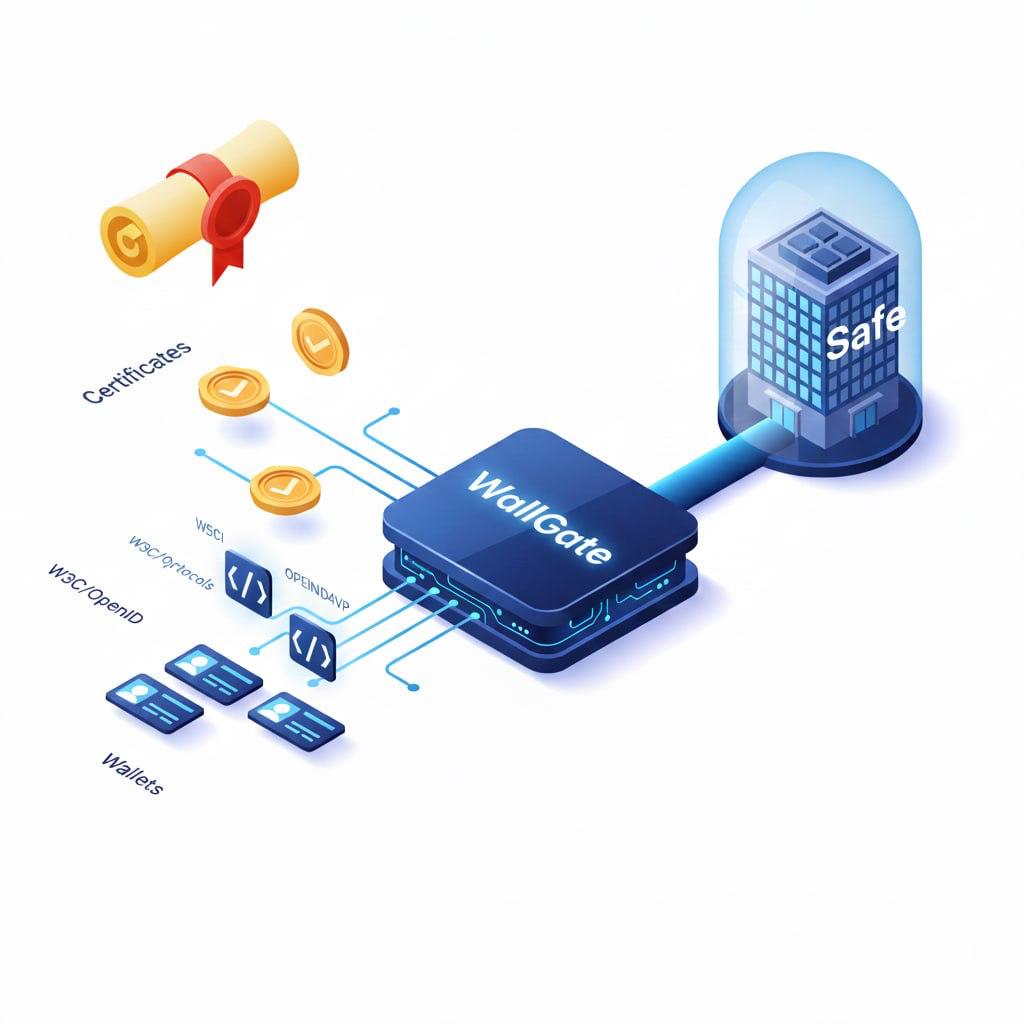
QuickGate operates as a EUDI Wallet Intermediary, functioning as a secure, stateless
gateway between Client Relying Parties (RPs) and User Wallet Units.
| Protocol |
Implementation Context |
| W3C Digital Credentials API (DC API) |
Primary. Used for all "Same-Device" flows. Whether the user
starts in a Client App or Client Website, the interaction is
mediated by the System Browser (Safari/Chrome) calling the
DC API. |
| OpenID4VP (OpenID
for Verifiable
Presentations) |
Underlying Engine. The payload format and request/response
structure used within the DC API and for Cross-Device QR
flows. |
| ISO/IEC 180135 |
Proximity. Supported for physical kiosk/in-person verification
via NFC or QR. |
2.2. Client Interfaces (Relying Party Backend To QuickGate Communication)
REST API: Protected by high-entropy API Keys (NF-SEC-002.1) and TLS 1.3.
Webhooks: Signed payloads sent to Client servers upon successful verification.
3. Authentication & Trust Architecture
3.1. Certificate Management (Legal & Tech Integration)
To comply with Article 5b(10) and the ARF, QuickGate manages the trust chain:
• RPAC (Access Certificate):
Identifies QuickGate as the certified Intermediary.
• RPRC (Registration Certificate):
Identifies the specific Client (End-RP) and authorizes
QuickGate to act on their behalf.
• Request Signing: Every OpenID4VP
request generated by the Gateway is signed using the
QuickGate private key associated with the RPAC, incorporating the Client's RPRC details in
the metadata.
3.1.1. Trust Chain Registration
To comply with EUDI Wallet trust framework, QuickGate must:
• Formally register as a Relying Party (Intermediary) with a Registrar
in our home Member
State
• Obtain RPAC (Relying Party Access Certificate) from an Access
Certificate Authority
(ACA)
• Maintain integration with EU Trusted Lists (LOTL) for QTSP validation
3.2. Verification Logic (NF-PER-002)
• Latency constraint: Cryptographic
verification must complete in < 1 seconds.
• Validation: Signatures of incoming
Verifiable Presentations (VPs) are checked against
the EU Trusted Lists (LOTL) to ensure the Wallet Provider is an authorized Qualified
Trust Service Provider (QTSP).
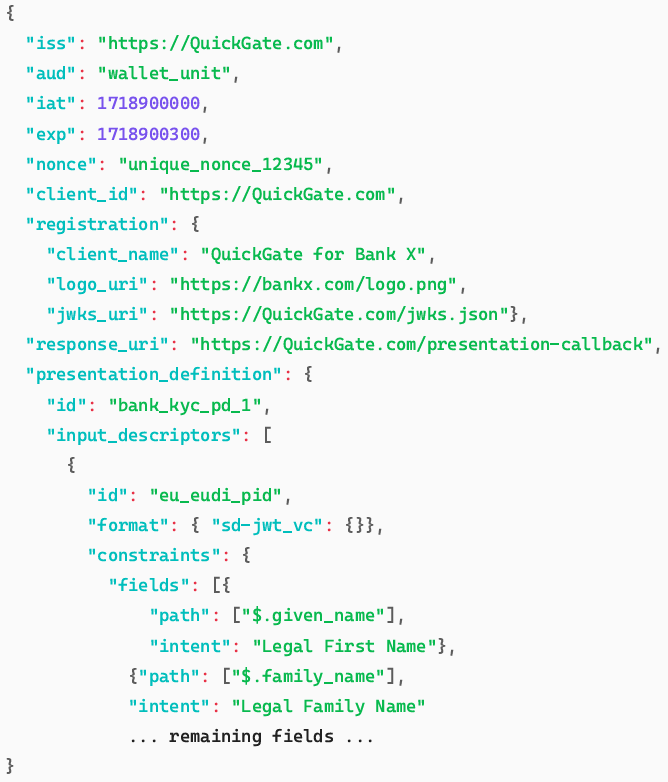
3.3. OpenID4VP Request Object Specification
Example demonstrating structure of the signed JWT payload:
4. Data Flows & Security
4.1. Same Device Flow
This section described flows in which end-user interacts via with clients app (either native
or web) on same device with the EUDI Wallet installed.
4.1.1. Scenario A: Native App Integration (Server-Init + PKCE + DC API)
Use Case: End-user interacting via a Client Native Application (iOS/Android)
with the Wallet
Unit installed on the same device.
Flow Overview: The QuickGate architecture enforces a "Secure Web Gateway"
pattern. Rather than the Client Application directly invoking the User Wallet, the user is
redirected to a transient, secure session hosted on the QuickGate Web Frontend.
This approach is chosen to leverage the W3C Digital Credentials API (DC API) as the primary
invocation mechanism. As detailed in the EU Digital Credentials API Discussion Paper (Topic F,
v1.3):
• Section 2.1 (Proposed Solution)
recommends the DC API to address "Session Binding" and "Clear Origin Verification," ensuring the
wallet interacts with a verified web origin.
• Section 3.1 (Expected
Functionality) emphasizes the browser's role in mediating secure wallet selection
and transport.
Primary Driver: Identity Consistency & Operational Scalability
The decision to route flows through a Web Gateway is primarily driven by the Origin
Association requirements of the Digital Credentials API.
• The Constraint: For a Native App
(e.g., com.client.bank ) to invoke the API on behalf of an Intermediary ( https://QuickGate.com
), the Operating System requires proof of association (e.g., Android
Digital Asset Links or iOS Associated Domains).
• The Problem: Direct native
invocation would require QuickGate to host the app
signatures of every client on its domain (hosted at
https://QuickGate.com/.well
known/assetlinks.json
). In the absence of these certificates, the Wallet will either
display a warning regarding the mismatch or block the request entirely as a potential
spoofing attempt. To support this natively, we would need to manage a massive JSON
file and update our server configuration every time a client releases a new app version
or rotates their keys. This creates an operational bottleneck that is impossible to scale.
• The Solution: By routing the flow
through verify.QuickGate.com
, the "Caller" is the
QuickGate System Browser. The Caller Origin perfectly matches the Relying Party
Identity (
QuickGate.com
), satisfying security checks without requiring any client
specific infrastructure configuration.
Secondary Driver: Platform Unification
Secondarily, this strategy resolves platform fragmentation. While Android supports direct
usage of the Digital Credentials API within native apps, iOS currently restricts this
API
surface to the browser context. By routing all native app flows through the
QuickGate Web
Gateway, we normalize this disparity, providing a single, consistent implementation path for
Clients across both mobile ecosystems.
The Initialization Lifecycle:
1. Indirect Initiation: The Client
App never communicates directly with QuickGate APIs.
2. Server-to-Server Trust: The
Client App requests a verification from its own Client Backend. The Client Backend then
authenticates with QuickGate Core (via Secret API Key) to initialize the session.
3. Session Generation: QuickGate
Core returns a unique, time-bound web_session_url containing a secure session token.
4. Handoff: The Client Backend
passes this URL to the Client App, which launches it in the System Browser to begin the secure
wallet interaction.
Architectural Rationale: This flow enforces a layered security model designed to
neutralize both remote relay attacks and local privilege escalation:
1. Authorization (Stripe-Model):
Only the Client Backend (holding a valid API Key) can initiate a verification session. This
ensures QuickGate processes requests exclusively from authorized partners.
2. Anti-Relay Mechanism (Delivery
Path): We mitigate Remote Relay Attacks by coupling result delivery to the user's
device context. The Authorization Code is delivered strictly via a system browser redirect to
the Client App on the victim's device. Consequently, a remote attacker who initiated the flow
never receives the code required to fetch the identity data.
3. Session Binding (PKCE): We
implement Proof Key for Code Exchange (RFC 7636) to
secure the Deep Link handoff on the local device. Since custom URL schemes (
app
scheme://
) are vulnerable to interception by malicious apps installed on the same
device, the Authorization Code (delivered in step 2) is
theoretically exposed. PKCE
mitigates this by requiring the
code_verifier
(generated securely at session start) to
redeem that code. A malicious app intercepting the code cannot exchange it for data
because it lacks the
code_verifier
stored in the legitimate app's memory.
4. Protocol Compliance: The
QuickGate Core generates the specific OID4VP
request_uri
(Signed JWT) required by the Digital Credentials API, abstracting the cryptographic
complexity and signing requirements from the Client.
5. Identity Consistency &
Scalability: As detailed in the "Primary Driver" section above, we verify user
identity via the QuickGate Web Gateway (System Browser) to solve the OS-level Origin Association
problem (Digital Asset Links), ensuring the Caller Origin matches the Request Signer.
The Detailed Flow:
Step 1: Client App Setup (PKCE Generation)
• Actor: Client Frontend (Native
App).
• Action:
• Generates a cryptographically random secret:
code_verifier
(e.g.,
secret_abc
)
• Hashes it:
code_challenge = SHA256(code_verifier)
.
• Sends the
code_challenge
to the Client Backend to start the process.
Step 2: Session Initialization (Server-to-Server)
• Actor: Client Backend →
QuickGate Core.
• Action:
• Authenticates using the Secret API
Key.
• Calls
POST /api/v1/sessions
with the
code_challenge
and requested attributes.
• QuickGate Core:
• Validates API Key.
• Generates a Wallet Nonce.
• Creates the Signed OID4VP Request Object
(JWT) containing the nonce and
return paths. Stores this as the
request_uri
.
• Internal Storage: Creates a
Session (Internal ID:
555
) storing the
code_challenge
,
request_uri
, and API Key owner.
• Public Handoff: Generates a
secure, random Session Token (e.g.,
sess_xyz123
)
mapping to Internal ID
555
.
• Returns the
web_session_url
containing this token:
https://verify.QuickGate.com/start?token=sess_xyz123
.
Step 3: Triggering the Flow
• Actor: Client Backend →
Client App → System Browser.
• Action:
• Client Backend returns the
web_session_url
to the App.
• Client App opens the System Browser (Safari/Chrome) to that URL.
Step 4: QuickGate Web & DC API Interaction
• Actor: QuickGate Web Frontend
(Browser) & User.
• Action:
• The QuickGate Page loads and parses the
token
from the URL.
• Context Fetch: The Frontend
JavaScript calls GET /api/session-context using the token.
• QuickGate Core: Validates the
token, retrieves the associated
request_uri
(the
Signed JWT), and returns it to the browser.
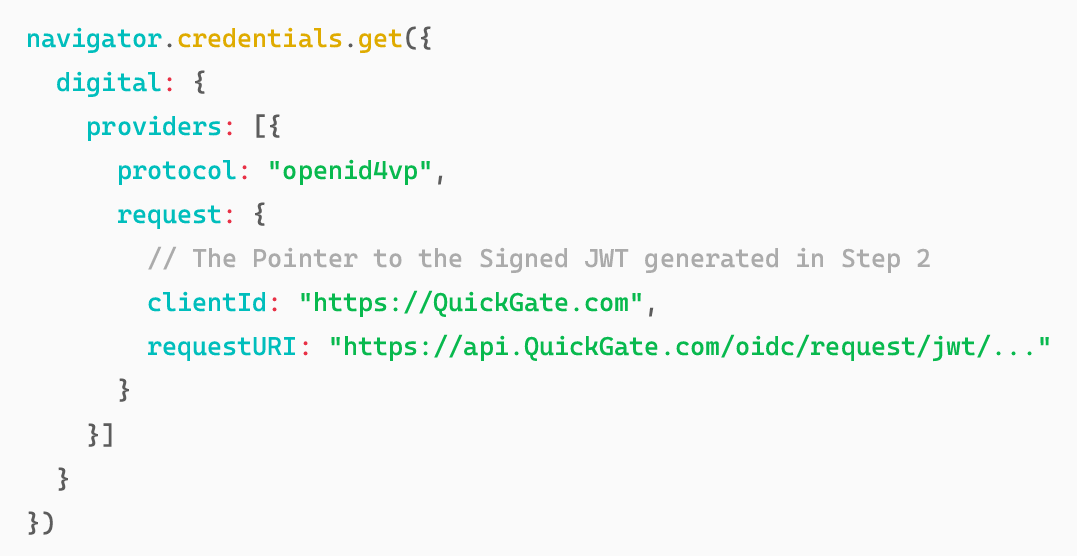
• Invocation: The JavaScript calls
the API:
• Browser/OS: Resolves the URI,
validates the signature, opens Wallet, and gets User Consent.
• Browser: Returns the Verifiable
Presentation VP object to QuickGate Frontend
memory.
Step 5: Verification & Code Issuance
• Actor: QuickGate Frontend →
QuickGate Core.
• Action:
• QuickGate Frontend sends an AJAX POST with the
vp_token
to the Core.
• QuickGate Core:
• Verifies the VP signature against the EU Trusted Lists (LOTL).
• Verifies the
nonce
inside the VP matches the one in the
request_uri.
• Success: Generates an Authorization Code (
auth_code_999
) linked to the original
code_challenge.
• Returns the code to the Frontend.
Step 6: The Return
• Actor: QuickGate Frontend →
Client App.
• Action:
• QuickGate Frontend redirects the browser to the client's callback:
bank-app://callback?code=auth_code_999.
Step 7: Secure Exchange
• Actor: Client App → Client
Backend → QuickGate Core.
• Action:
• Client App sends auth_code_999
AND the secret
code_verifier
to Client Backend.
• Client Backend calls POST /api/v1/token
(using API Key).
• QuickGate Core:
• Validates API Key.
• Checks: SHA256(code_verifier) == code_challenge
(stored in Step 2).
• Result: Returns the verified User
Attributes.
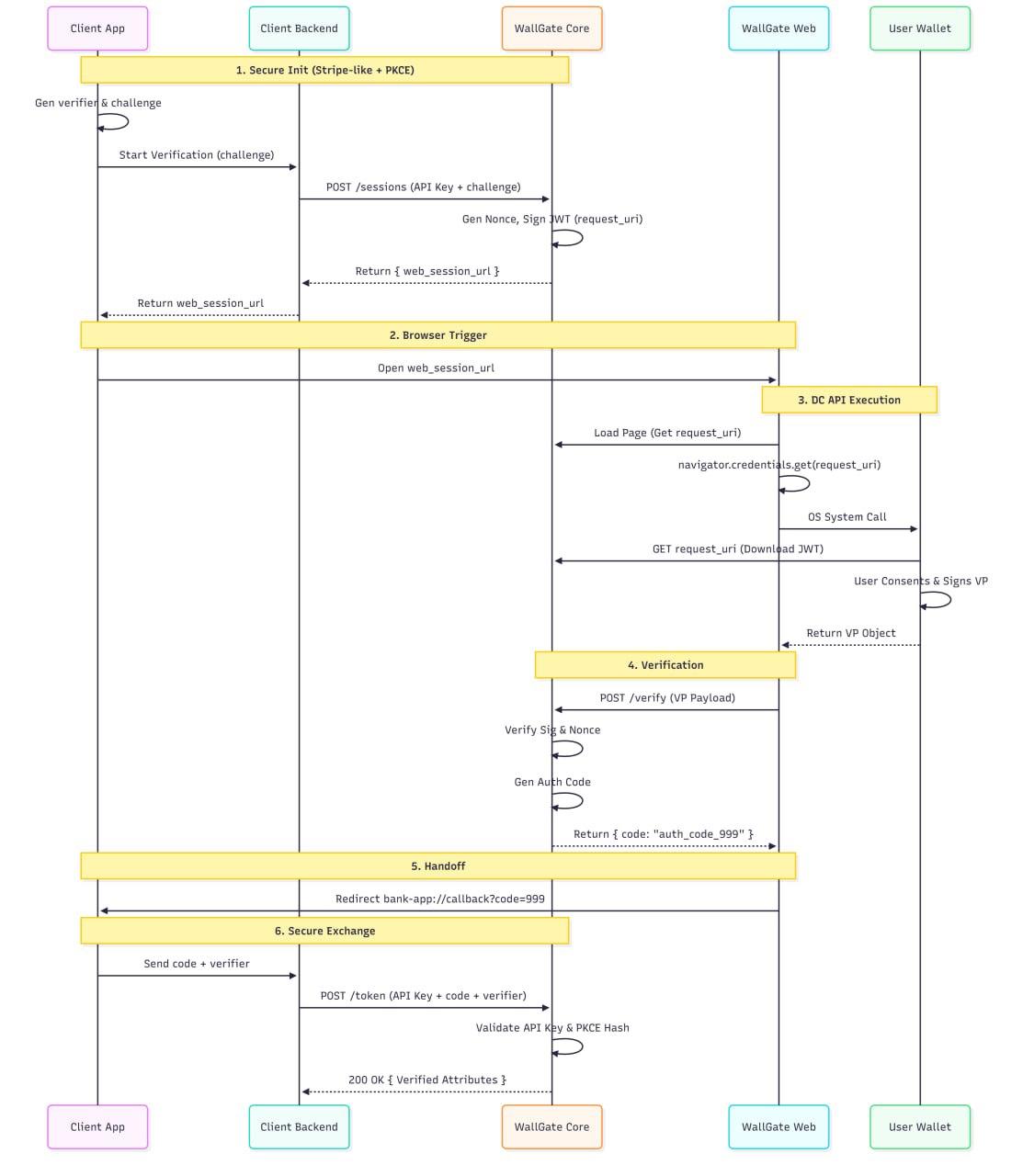
Figure 4.1.1: Native App - Same Device Authentication Sequence
4.1.2. Scenario B: Web Client Integration (Secure Pop-up Flow)
Use Case: End-user interacting via a Client Web Application (Browser). The
Wallet Unit is
installed on the same device.
Architectural Rationale: Unlike Native Apps, Web Clients already operate within
a browser
environment, theoretically allowing them to invoke the Digital Credentials API directly.
However, we strictly route the flow through the QuickGate Web Gateway to enforce Origin
Consistency (as detailed in Section 4.1). Since the OpenID4VP
Request is cryptographically
signed by QuickGate's certificate (RPAC), invoking it from a different Client domain would
cause a mismatch between the Calling Origin and the Request
Signer, triggering security
warnings or blocking by the User's Wallet.
• The Constraint: The OpenID4VP
Request is signed by QuickGate's RP Access
Certificate.
• The Security Requirement: To
prevent "Origin Mismatch" errors or Phishing warnings in
the User's Wallet, the browser's Top-Level Origin (calling the API) must match the
Certificate Signer (
QuickGate.com
).
• The UX Solution: We use a Pop-up
Architecture (via the QuickGate Web SDK) to load
the Secure Gateway in a modal window, maintaining the user's context on the Client
Website while satisfying the Origin security requirement.
The Detailed Flow:
Step 1: Session Initialization (Stripe-like)
• Actor: Client Backend →
QuickGate Core.
• Action: Authenticates via API Key
and calls
POST /sessions.
• Return: QuickGate returns the
web_session_url
(e.g.,
https://verify.QuickGate.com/start?token=sess_123
).
• Handoff: Client Backend passes
this URL to the Client Frontend (JS).
Step 2: The Pop-up Trigger (QuickGate Web SDK)
• Actor: Client Frontend (User).
• Action: User clicks "Verify
Identity".
• SDK Action:
• Instead of a full page redirect, the SDK opens a Pop-up Window pointing to
web_session_url.
• Note Pop-ups are required (rather than iFrames) because the Digital
Credentials
API typically requires a top-level browsing context or specific Permissions Policy
delegation, and Wallet System Dialogs function best from top-level windows.
Step 3: DC API Execution (Inside the Pop-up)
• Actor: QuickGate Frontend (Pop-up
Window).
• Context: The browser is now
strictly on
https://verify.QuickGate.com.
• Action:
• The Frontend JS retrieves the
request_uri.
• Calls
navigator.credentials.get().
• Security Check: The Browser Origin
(
QuickGate.com
) matches the Request Signer
(
QuickGate.com
). The Wallet trusts the interaction.
• Wallet Interaction: User completes
the flow; VP is returned to the Pop-up's
memory.
Step 4: Verification & Closure
• Actor: QuickGate Frontend →
QuickGate Core.
• Action: POSTs the VP for
verification.
• Success: QuickGate Core verifies
the proof and returns an Authorization Code.
Step 5: Cross-Window Communication (PostMessage)
• Actor: QuickGate Frontend (Pop-up)
→ Client Frontend (Parent Window).
• Action:
• The Pop-up does not redirect.
• Instead, it uses the
window.opener.postMessage
API to send the Authorization
Code securely to the Parent Window.
• The Pop-up closes itself automatically.
Step 6: Token Exchange
• Actor: Client Frontend →
Client Backend →
QuickGate Core.
• Action: The Client Frontend passes
the code to its Backend, which exchanges it for the
User Attributes (same as Scenario A).
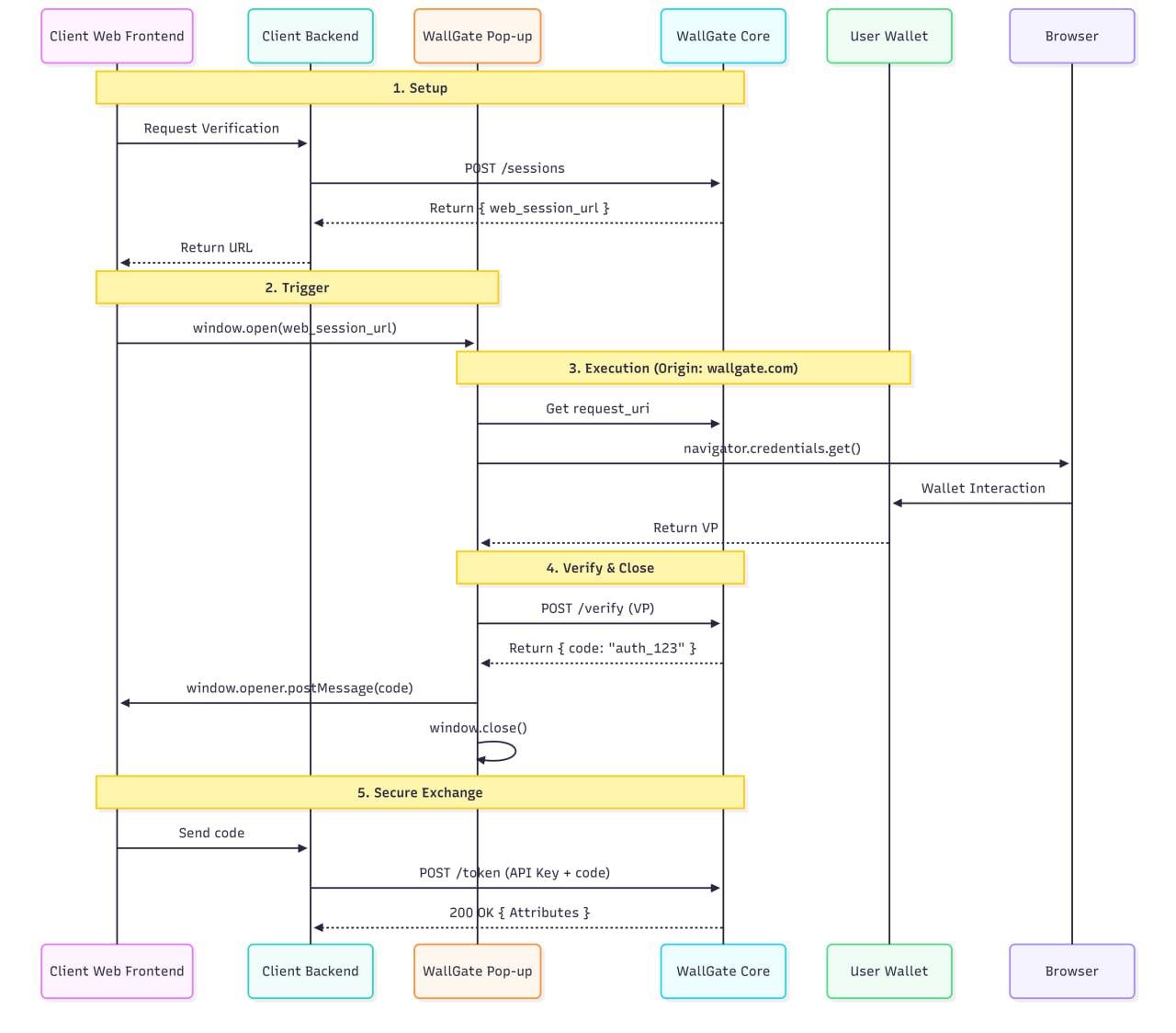
Figure 4.1.2: Web Client Same Device Authentication Sequence
4.2. Cross-Device Flow
This section details flows where the End-User initiates the verification on one device (e.g.,
a Desktop, Laptop, or Tablet) while the EUDI Wallet is hosted on a separate device (e.g., a
Smartphone).
4.2.1. Scenario A: Native App Integration (Tablet/Desktop App)
Use Case: End-user interacting via a Client Native Application (e.g., on an iPad
or Android
Tablet) with the Wallet Unit installed on a smartphone.
Flow Overview: The initialization and handoff process mirrors Scenario
4.1.1. The Client
Backend initializes the session and the Client App opens the QuickGate Web
Gateway in
the System Browser.
Architectural Rationale:
• The Challenge: A standard
OpenID4VP implementation using
response_mode=direct_post
enables the Wallet to send credentials directly to the
Backend over the internet. While broadly supported, this approach is vulnerable to
Remote Relay Attacks. A remote attacker could display a
"Direct Post" QR code to a
victim, and if the victim scans it, the Wallet would push the credentials to the Backend,
bypassing the attacker's lack of physical presence.
• The Solution (DC API & CTAP): We
explicitly reject the
direct_post
method for cross
device flows. Instead, we invoke the Digital Credentials API,
which utilizes the CTAP
(Client to Authenticator Protocol) Hybrid Flow.
• Proximity Security: This protocol
routes the credentials from the Wallet (Phone) to the
Browser (Tablet) via a secure local tunnel, enforced by a Bluetooth
(BLE) Proximity
Check. If the devices are not physically close, the connection fails. This renders
Remote Relay Attacks impossible.
The Detailed Flow:
Steps 1-3: Initialization
• Identical to Section 4.1.1. The
Client App generates a PKCE challenge, the Backend
creates a session, and the App launches the web_session_url in the Tablet's System Browser.
Step 4: Secure Tunnel Establishment
• Actor: QuickGate Frontend (Tablet
Browser).
• Action: Calls
navigator.credentials.get().
• Browser UI: The Browser displays a
system-generated QR code.
• User Action: User scans the QR
code with their Smartphone Wallet.
• Security Check: The devices
perform a Bluetooth Handshake to verify physical proximity.
• Tunneling: A secure, end-to-end
encrypted tunnel (CTAP Hybrid) is established
between the Wallet (Phone) and the Browser (Tablet).
Step 5: Data Transfer & Return
• Action: The Wallet sends the
Verifiable Presentation (VP) through the secure tunnel to
the Tablet Browser's memory.
• Note: The VP is not posted
directly to the QuickGate Backend from the phone. It returns to the calling context (the
Browser) to resolve the JavaScript Promise.
Step 6-7: Verification & Handoff
• Action: The QuickGate Frontend
(Tablet) POSTs the VP to the QuickGate Core, receives
the Authorization Code, and redirects back to the Native App (client-app://callback) exactly as
described in Section 4.1.1.
4.2.2. Scenario B: Web Client Integration (Desktop Browser)
Use Case: End-user interacting via a Client Web Application (e.g., Banking
Website on a Desktop) with the Wallet Unit installed on a smartphone.
Flow Overview: The initialization process mirrors Scenario
4.1.2. The Client Website opens the QuickGate Pop-up Window to
maintain Origin Consistency.
Architectural Rationale:
• The Challenge: As with the Native
App scenario, utilizing a standard
response_mode=direct_post
QR code allows the Wallet to transmit data over the
internet from anywhere. This creates a vulnerability to Remote Relay
Attacks, where a
remote attacker presents a QR code to a victim, and the victim's scan successfully
authorizes the attacker's session.
• The Solution (DC API & CTAP): We
mitigate this by strictly avoiding
"Direct Post" flows.
By invoking the Digital Credentials API within the QuickGate
Pop-up, we trigger the
CTAP Hybrid Flow.
• Proximity Security: This forces a
Bluetooth (BLE) Proximity Check. The
Wallet verifies
that it is physically next to the Desktop computer requesting the identity before
releasing any data. This ensures that the user is not being phished by a remote
attacker.
The Detailed Flow:
Steps 1-2: Initialization
• Identical to Section 4.1.2. The
Client Backend creates the session, and the Client Website opens a Pop-up Window pointing to the web_session_url
Step 3: Secure Tunnel Establishment
• Actor: QuickGate Frontend (Pop-up
Window on Desktop).
• Action: Calls
navigator.credentials.get().
• Browser UI: The Pop-up displays
the system-generated QR code.
• User Action: User scans the QR
code with their Smartphone Wallet.
• Security Check: The devices
perform a Bluetooth Handshake to verify physical proximity.
• Tunneling: A secure, end-to-end
encrypted tunnel (CTAP Hybrid) is established between the Wallet (Phone) and the Desktop
Browser.
Step 4: Data Transfer & Return
• Action: The Wallet sends the
Verifiable Presentation (VP) through the secure tunnel to the
Pop-up Window's memory.
• Note: The VP is returned to the
browser context, not posted directly to the backend from the phone.
Step 5-6: Verification & Handoff
• Action: The QuickGate Frontend
(Pop-up) POSTs the VP to the QuickGate Core, receives the Authorization Code, and passes it to
the Parent Window via window.opener.postMessage, exactly as described in Section 4.1.2.
4.3. Security Enhancement: Bi-Directional Triangular Encryption
Architectural Rationale:
While TLS 1.3 secures data in transit over the public internet, standard HTTPS termination
occurs at the infrastructure edge (e.g., Cloudflare WAF, Cloud Load Balancers, Kubernetes
Ingress). This implies that legally sensitive User Attributes (PII) and Authentication Secrets
exist in plaintext within these intermediate systems and their associated logs before
reaching the core logic.
To mitigate this, we implement Application-Layer Encryption (ALE). This
architecture
treats all intermediate network infrastructure as "Blind Proxies." By
encrypting the payload
at the application level (JWE), we ensure that data remains cryptographically opaque to
WAFs, load balancers, and cloud monitoring tools (e.g., Datadog, Splunk), preventing
accidental exposure in infrastructure logs.
To achieve a true Zero Trust architecture, we further refine this by
acknowledging that the
Client Backend serves two distinct roles with different privilege requirements:
1. Blind Proxy for Credentials: It
relays the authorization proofs
(authorization_code, code_verifier) from the App to QuickGate. It does not need to read
these secrets.
2. Consumer of Identity: It receives
the verified User Attributes to generate a session.
It must be able to read this data.
We implement a Triangular Encryption Model (or "Sealed Request" pattern) to map
these
trust boundaries precisely to the cryptography.
The Cryptographic Flow:
1. Key Provisioning (The Triangle)
• QuickGate Public Key: Distributed
via the QuickGate Client SDK (Mobile/Web) or
provided during the Onboarding Configuration. Used by the Client
App to seal the
request.
• Client Backend Public Key:
Registered with QuickGate Core during the Onboarding
Process. Used by QuickGate to encrypt the response.
• Client Backend Private Key:
Generated by the client and stored strictly in the Client
Backend HSM (Hardware Security Module) or Secure Vault.
2. The Sealed Request (Client App → QuickGate)
• Actor: Client App (via QuickGate
SDK).
• Action: The SDK bundles the
authorization_code and code_verifier.
• Encryption: The SDK encrypts this
payload using QuickGate's Public Key.
• Transit: The Client App sends this
"Sealed Blob" (JWE) to the Client Backend via standard TLS.
• Relay: The Client Backend cannot
read the blob. It attaches its own Secret API Key in the standard HTTP Headers and forwards the
payload to QuickGate Core.
• Architectural Note: The API Key remains visible to the Infrastructure
Layer (API
Gateway/WAF) to enable high-speed Rate Limiting and DoS protection for
unauthenticated traffic.
• Security Binding: To mitigate API Key theft, the Client App includes
its client_id inside the encrypted JWE payload. QuickGate
Core decrypts the
payload and validates that the client_id inside the blob matches the account
associated with the API Key in the header. A mismatch indicates that the API Key is
being used out of context (e.g., stolen or replay attempt), triggering an immediate
rejection.
• Benefit: Authentication secrets
are never exposed to the Client Backend's logs, crash
reports (e.g., Sentry/Firebase), or internal traffic sniffers, while the Infrastructure
remains capable of protecting the Core.
3. The Trusted Response (QuickGate -> Client Backend)
• Actor: QuickGate Core.
• Action: QuickGate decrypts the Sealed Request (using its own Private
Key) and verifies
the proofs. It retrieves the User Attributes.
• Encryption: QuickGate encrypts the Identity Data using the Client
Backend's Public Key.
• Transit: The encrypted JWE is returned to the Client Backend.
• Decryption: The Client Backend uses its Private Key to decrypt the
PII in volatile memory, creates the Access Token, and wipes the data.
Table 4.3 Summary of Data Exposure
| Data Segment |
Visible to Client App? |
Visible to Client Backend? |
Visible to QuickGate? |
| Auth Secrets
(
code
/
verifier
) |
Yes (Originator) |
NO (Encrypted) |
Yes (Verifier) |
| Identity Data (PII) |
NO (Only Token) |
Yes (Consumer) |
Yes (Provider) |
5. SDK Strategy: Accelerating Adoption & Ensuring
Consistency
5.0. Why SDKs are Crucial for Success
1. Dramatically Easier
Integration: Clients avoid OpenID4VP, JWT verification, and
cryptographic complexity
2. Reduced Time-to-Market:
Integration becomes hours/days instead of weeks/months
3. Fewer Support Tickets:
Protocol changes require only SDK updates, not client re
integration
4. Consistent Implementation:
Ensures all clients handle errors, timeouts, and user flows
correctly
5. Competitive Advantage:
Well-designed SDKs create significant switching costs and
differentiation
5.1. Server-Side SDK (Node, Java, Python)
Enhanced Responsibilities:
• Authentication (API Key management) and session creation
• Webhook signature verification with HMAC validation
• Error handling and retry logic normalization
Security Benefit: Keeps client secrets off the frontend entirely
5.2. Client-Side SDK (Mobile - Android/iOS)
Enhanced Responsibilities:
• Receives
web_session_url
from backend (never constructs it client-side)
• Safely launches System Browser with anti-phishing protections
• Listens for deep link callbacks and handles app state restoration
• Provides pre-built UI components for consistent user experience
5.3. Client-Side SDK (Web)
Enhanced Responsibilities:
• Renders "Verify with Wallet" button with auto device detection
• Mobile: Redirects to QuickGate verification URL
• Desktop: Renders Cross-Device QR Code
• Built-in analytics and error tracking
6. Operational Management: Admin Dashboard & Client Portal
While the Gateway Core handles the real-time verification flows, the Admin Dashboard
serves as the primary interface for Relying Parties to manage their QuickGate integration,
monitor operations, and maintain their compliance settings. It is a separate, secure web
application that interacts with the Gateway's management APIs.
6.1. System Architecture & Isolation
Principle: The Dashboard is a client-facing Management
Plane, physically and logically
separated from the high-throughput, security-critical Data Plane (the
Gateway Core). This
isolation ensures that management activities do not impact the performance or security of
live verification sessions.
• Separate Application Stack:
The Dashboard runs on its own set of compute instances,
with dedicated databases for client configuration and metadata.
• API First Design: All
dashboard functions are driven by a secure set of internal RESTful
APIs provided by the Gateway Core's management endpoints.
6.2. Core Functional Modules & Technical Implementation
The dashboard's capabilities directly fulfill the requirements outlined in
F-OPS-001.
6.2.1. Client Onboarding & API Key Management (F-OPS-001.1)
This module handles the initial integration setup for a new client.
• Account Registration &
Vetting: A multi-step UI guides new clients through providing
their legal entity details, which are submitted for the initial RPRC registration process.
• API Key Generation: Upon
successful onboarding, the system:
• Generates a high-entropy, unique
client_id
and
api_key
pair.
• Securely stores a bcrypt-hashed version of the
api_key
in the management
database.
• Displays the
api_key
in clear text only once to the client upon generation, after
which it is irrecoverable and must be rotated if lost.
• Webhook Configuration: Clients
can register one or more endpoint URLs for receiving
verification results. The UI allows for testing the webhook endpoint.
6.2.2. Usage Monitoring & Analytics (F-OPS-001.2)
This module provides visibility into verification activities, strictly adhering to data
minimization (NF-PRI-001.3).
• Real-Time Metrics Dashboard: A
UI populated by streaming analytics data (e.g., via
WebSockets or frequent API polls) displays:
• Transactions per second/minute
• Success/Failure rate gauges
• Average verification latency
• Historical Reporting: Clients
can filter and view aggregated, non-PII transaction logs by
date range, status (
verified
,
failed
,
user_rejected
), and error code.
• Data Source: All metrics are
generated from metadata logs (e.g.,
transaction_id
,
timestamp
,
status
,
error_code
,
client_id
,
requested_attributes_list) emitted by
the Gateway Core to a dedicated analytics pipeline (e.g., Kafka stream processed by
Flink/Spark).
6.2.3. Configuration Management (F-OPS-001.3)
This is the central hub for clients to define how they use the QuickGate service.
• Attribute Set Management:>
• A UI form allows clients to create and name different
"Verification Profiles" (e.g.,
"Basic KYC", "Age Verification").
• For each profile, clients select the required user attributes
from a pre-defined,
ARF-aligned schema using a checkbox interface. This configuration is stored as a
JSON
presentation_definition
template.
• RPRC & Legal Entity Linking:
• The dashboard displays the status of the client's RPRC (e.g.,
Expired).
• Clients can select which active RPRC and associated "Verification
Profile" to use
for different parts of their application.
• Billing Settings:
• Integrates with the payment provider (e.g., Stripe). Clients can
view current usage
against their plan, download invoices, and update payment method details.
6.3. Security Model for the Dashboard
• Authentication: Clients log in
using a separate set of credentials (e.g., Email/Password,
SSO). Multi-Factor Authentication (MFA) is enforced.
• Authorization: All requests
from the Dashboard UI to the internal Management API are
authenticated using a session token and authorized based on the
client_id
to ensure
clients can only access their own data and configurations.
• Audit Logging: Every
configuration change made via the Dashboard (e.g., API key
rotation, webhook update) is logged for security and compliance auditing.
7. End-to-End Verifiable Audit Trail
To ensure cryptographic non-repudiation and process integrity without compromising the
"Zero-Persistence" privacy model, QuickGate implements a Dual-Layer Audit
Architecture.
This combines a public transparency log with client-side sealed evidence.
A. Layer 1 The Transparency Log (Integrity Anchor)
QuickGate maintains a Merkle-Tree based Transparency Log to prove the existence and
timing of every verification request.
1. Hashing: Upon completion of a
verification, QuickGate generates a cryptographic hash
of the transaction metadata: SHA256(Transaction_ID + Timestamp + LOTL_Fingerprint
+ Hash(Wallet_Signature)). Crucially, no PII (Personally
Identifiable Information) or
raw attribute values are included in this hash.
2. Aggregation: These
transaction hashes are aggregated into a Merkle Tree structure.
3. Anchoring: The Merkle Root is
periodically anchored to a public ledger (e.g., Ethereum
or a specialized Transparency Log).
4. Purpose: This creates an
immutable public record that a specific verification event
occurred at a specific time, preventing QuickGate from retroactively altering transaction
logs or fabricating history.
B. Layer 2 The Sealed Evidence Pattern (Content Proof)
While QuickGate proves the existence of the transaction, the Client must retain the content
for legal defense. Since QuickGate wipes data immediately, the Spec mandates a
Sealed
Evidence Strategy for Clients via the SDK:
1. Sealing: Upon receiving the
webhook payload, the Client SDK bundles the verified
attributes PII and the raw
wallet_signature.
2. Encryption: This bundle is
immediately encrypted using a dedicated Audit Public Key
(owned by the Client, with the Private Key held in offline cold storage/HSM).
3. Storage: The Client stores
this Encrypted Audit Blob in their database.
4. Purpose: This ensures that
PII remains inaccessible during daily operations (satisfying
GDPR Data Minimization) but is cryptographically recoverable by the Client's
Compliance Officer in the event of a regulatory audit or dispute.
C. The Verification Link
In the event of a dispute, an auditor decrypts the Client's Sealed Evidence
to retrieve the
original
wallet_signature. By hashing this signature, the auditor can locate the
corresponding record in QuickGate's Transparency Log (Layer 1). This
mathematically
proves that the data held by the Client is exactly what was verified by QuickGate at that
specific moment in time.
8. Non-Functional Implementation Details
8.1. Security (NF-SEC)
Encryption: All data in transit protected via TLS 1.3.
Format Support: Parsing engines for SD-JWT (Identity) and mdoc/CBOR
(Driver's Licenses)
as per NF-SEC-003.1.
>Replay Protection: strict nonce validation on every request to prevent
replay attacks.
8.2. Privacy & Data Minimization (NF-PRI)
8.2.1. The "Secure Pipe" Architecture
Memory-Only Processing Pipeline:
1. Receive Verifiable Presentation in volatile memory
2. Extract ONLY requested attributes (data minimization)
3. Verify trust chain against EU Trusted Lists
4. Immediately forward to Client Webhook
5. Force garbage collection and memory overwrite
Logging Constraints:
• Zero PII in logs, metrics, or analytics
• Only
transaction_id
, timestamp, status, error_code
• No attribute values, wallet identifiers, or user identifiers
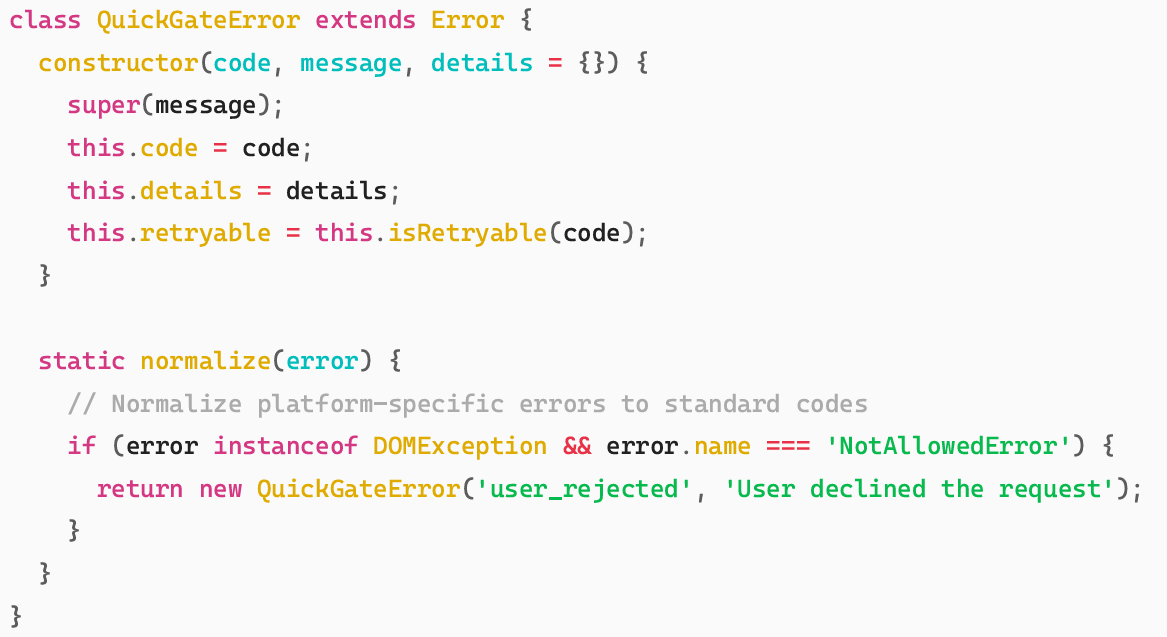
8.2.2. Comprehensive Error Handling
Error Normalization:
Standard Error Code Examples:
• user_rejected:
User explicitly declined consent
• timeout:
Verification request timed out
• wallet_unavailable:
No certified wallet installed
• network_error:
Temporary connectivity issues
• invalid_request:
Malformed presentation request
8.3. Scalability (NF-PER)
Stateless Core: The Gateway does not maintain sticky sessions. Session state
is stored in a
distributed ephemeral cache (e.g., Redis) allowing the Core to scale horizontally to meet
the 99.9% availability target.
8.4. Session State Management and Reliability (NF-PER-001/002)
The system must ensure high reliability and responsiveness, especially during the critical
authentication window.
Table 8.4: Requirements for Session State Management and Reliability
| Requirement |
Implementation Detail |
Rationale |
| Real-Time Status |
Server-Sent Events SSE or
WebSockets MUST be used for the
QuickGate Web client to listen for status
changes from QuickGate Core. |
Eliminates inefficient
polling and provides
immediate feedback,
significantly improving NF-PER-002 (Latency) and
user experience. |
| Session TTL (Backend) |
All sessions MUST have a hard
expiration (TTL) of 300 seconds (5
minutes) enforced in the distributed
ephemeral cache. |
Security and Data
Minimization (NF-PRI-001). Prevents "zombie"
sessions and adheres to
time-limited transaction
standards. |
| Request
Expiration
(OpenID4VP) |
The generated JWT Request Object
MUST include an
exp
claim set to
iat
+ 300 seconds. |
Ensures the Wallet Unit
itself refuses to submit
data for an expired
transaction, aligning with
OpenID4VP security best
practices. |
| SSE Client
Timeout |
The QuickGate Web client MUST
implement a disconnection timeout
corresponding to the Session TTL. If the
SSE stream breaks or remains idle past
the session TTL, the client stops waiting
and displays an "Expired" message. |
Provides graceful failure
for network issues or
server crashes, ensuring
the user is not stuck on a
loading screen indefinitely. |
| Backend
Crash Handling |
When QuickGate Core receives a
successful Direct POST from the Wallet,
it MUST immediately verify the VP and
send the webhook before responding to
the Wallet, ensuring successful delivery
is guaranteed before PII is wiped. |
Guarantees that the Client
Backend is notified even if
the QuickGate Core fails
immediately after VP
reception. |
9. Compliance Assurance
The Technical Specifications successfully implement all Functional Requirements
(FR)
and Non-Functional Requirements (NFR).
Table 9.1: Implementation of Functional Requirements (FR)
| Functional
Requirement Area |
Implementation in Technical Specifications |
| F-CORE-001:
Session
Management |
Detailed in Section 4.1. The POST /api/v1/sessions API
creates
sessions. Session state is managed in a distributed cache with a
5-minute TTL as defined in Section 8.4. |
| F-CORE-002:
Credential
Processing |
Section 3.2 outlines verification logic against EU
Trusted
Lists. Section 8.1 confirms support for SD-JWT/mdoc
formats. The
"Secure Pipe" architecture in Section 8.2.1 enforces
data
minimization. |
| F-CORE-003:
Secure Data
Forwarding |
The core data flow in Section 4.1 shows immediate
forwarding via
TLS. The "Memory-Only Processing Pipeline" in Section
8.2.1 explicitly mandates memory wiping post-forwarding.
|
| F-CORE-004:
Integrity & Audit |
Section 7 details the "Dual-Layer Audit Architecture."
It
implements F-CORE-004.1 (Transparency Log/Merkle Tree)
and F-CORE-004.2 (Sealed Evidence) to ensure
non-repudiation. |
| F-CLIENT-001:
API & SDK
Interfaces |
Section 2.2 defines the REST API, and Section
5 is dedicated to the
SDK strategy. The presentation_definition in Section
3.3 implements the Attribute Request Schema. |
| F-CLIENT-002:
UI Integration |
The primary user flows (Scenario A, B in Section 4)
directly
implement Same-Device and Cross-Device flows. Status Polling via
SSE is mandated in Section 8.4. |
| F-PROTOCOL-001/002:
Protocols |
Section 2.1 clearly defines OpenID4VP as the underlying
engine and
DC API as the primary interface. Support for ISO 18013-5 is stated
in Section 2.1. |
| F-OPS-001:
Admin Dashboard |
Section 6 provides a dedicated architectural breakdown
of the
Admin Dashboard, explicitly detailing Client Onboarding (6.2.1),
Usage Monitoring (6.2.2), and Configuration (6.2.3). |
Table 9.2: Implementation of Non-Functional Requirements (NFR)
| Requirement |
Implementation Detail |
Rationale |
| Real-Time Status |
Server-Sent Events SSE or
WebSockets MUST be used for the
QuickGate Web client to listen for status
changes from QuickGate Core. |
Eliminates inefficient
polling and provides
immediate feedback,
significantly improving NF-PER-002 (Latency) and
user experience. |
| Session TTL (Backend) |
All sessions MUST have a hard
expiration (TTL) of 300 seconds (5
minutes) enforced in the distributed
ephemeral cache. |
Security and Data
Minimization (NF-PRI-001). Prevents "zombie"
sessions and adheres to
time-limited transaction
standards. |
| Request
Expiration
(OpenID4VP) |
The generated JWT Request Object
MUST include an
exp
claim set to
iat
+ 300 seconds. |
Ensures the Wallet Unit
itself refuses to submit
data for an expired
transaction, aligning with
OpenID4VP security best
practices. |
| SSE Client
Timeout |
The QuickGate Web client MUST
implement a disconnection timeout
corresponding to the Session TTL. If the
SSE stream breaks or remains idle past
the session TTL, the client stops waiting
and displays an "Expired" message. |
Provides graceful failure
for network issues or
server crashes, ensuring
the user is not stuck on a
loading screen indefinitely. |
| Backend
Crash Handling |
When QuickGate Core receives a
successful Direct POST from the Wallet,
it MUST immediately verify the VP and
send the webhook before responding to
the Wallet, ensuring successful delivery
is guaranteed before PII is wiped. |
Guarantees that the Client
Backend is notified even if
the QuickGate Core fails
immediately after VP
reception. |
9. Compliance Assurance
The Technical Specifications successfully implement all Functional
Requirements
(FR)
and Non-Functional Requirements (NFR).
Table 9.1: Implementation of Functional Requirements (FR)
| Non-Functional
Requirement Area |
Implementation in Technical Specifications |
| NF-SEC: Security |
Zero-Trust architecture is fundamental. TLS 1.3/Triangular
Encryption are defined in Section 4.3. Section
7 implements NF-SEC-004
(Auditability) via the Transparency Log, ensuring
non-repudiation without PII storage. |
| NF-PRI: Privacy &
Data Protection |
The "Zero-Persistence" and "Secure Pipe" principles in
Section
1.1 and Section 8.2.1 directly
fulfill NFPRI 001. The architecture
supports ISO 27001/27701 compliance as detailed in
Section 8.2.
|
| NF-INT:
Interoperability |
Section 2.1 provides a clear matrix of
supported protocols
(OpenID4VP, DC API) and scenarios (Same-Device, Cross-Device,
Proximity). |
| NF-PER: Reliability
& Performance |
The system is designed as stateless for horizontal scaling
(Section 8.3). The 1-second latency target is
stated in Section
3.2. Session reliability is defined in
Section 8.4.
|
3. Alignment with Business, Legal, and Market Goals
• Business
Model: The stateless, API-driven gateway enables precise
Pay-As-You-Go
metering.
• Legal Solution: Section
3.1 details RPAC/RPRC management ("Compliance by
Proxy"). Section 7 (Audit) provides the
critical "Evidence for Defense" capability
required by legal teams.
• Market
Advantage: The SDK Strategy
(Section 5) and Dashboard (Section 6)
deliver
on the promise of "Stripe-like" simplicity.
Part 3: Functional Specifications (F-REQS)
The "What" Scope of Capabilities.
This section outlines the core functional requirements of the QuickGate platform, detailing
the specific tasks the system must perform to achieve its purpose as a compliant EUDI
Wallet Intermediary.
1. Gateway Core Services (The Intermediary Role)
The Gateway Core is the heart of QuickGate, responsible for managing the entire identity
verification lifecycle between the Relying Party (Client) and the EUDI Wallet Unit.
1.1. Verification Session Management (F-CORE-001)
The system must generate, manage, and secure a unique, time-limited verification session
for every identity request initiated by a client.
• F-CORE-001.1 (Session Creation):
Create a secure, single-use session upon receiving
an identity request from a Client Server SDK.
• F-CORE-001.2 (Request Generation):
Generate a valid OpenID4VP Request Object (as
a signed JWT) containing the requested attributes, callback URI, and nonce specific to
the session.
• F-CORE-001.3 (Session State): Maintain
the state of the session (e.g., Awaiting
Presentation, Verification In Progress, Success, Failed) without storing the requested
PII.
• F-CORE-001.4 (Time-Out): Automatically
time out and invalidate sessions that remain
inactive for a predefined period (e.g., 5 minutes) to mitigate risk.
1.2. Credential Processing & Validation (F-CORE-002)
Upon receiving a Verifiable Presentation from a User Wallet, the system must perform
mandatory cryptographic checks.
• F-CORE-002.1 (Signature Validation):
Cryptographically validate the signature of the
Verifiable Presentation (VP) against the corresponding Wallet Unit's key, using the EU
Trusted Lists for certificate chain validation.
• F-CORE-002.2 (Credential Decoding):
Successfully decode and parse credentials
presented in mandated formats: SD-JWT and mdoc (CBOR/COSE).
• F-CORE-002.3 (Data Minimization
Enforcement): Functionally extract only the
attributes requested by the Client and consented to by the user, discarding all
extraneous data.
• F-CORE-002.4 (Replay Protection):
Implement and enforce nonce checking to prevent
the fraudulent reuse of a presentation in subsequent sessions.
1.3. Secure Data Forwarding and Wiping (F-CORE-003)
Adhering to strict Data Minimization requirements, the system must process data in a
memory-only environment.
• F-CORE-003.1 (Forwarding): Immediately
forward the verified, extracted user
attributes to the Client's pre-configured webhook endpoint via a secure, authenticated
channel (TLS 1.3).
• F-CORE-003.2 (Memory Wipe):
Functionally and programmatically destroy all
processed PII and attribute data from volatile memory RAM immediately upon successful forwarding to
the client.
1.4. Integrity & Audit Services (F-CORE-004)
The Core must generate and distribute cryptographic proofs of verification.
• F-CORE-004.1 (Transparency Logging):
For every completed session, the system must
compute a cryptographic hash of the transaction metadata and Wallet Signature, and
append this hash to an immutable, append-only log (e.g., Merkle Tree)
• F-CORE-004.2 (Evidence Delivery): The
system must return the
raw wallet_signature to the Client (via Webhook/SDK) to enable the "Sealed Evidence"
pattern, allowing the Client to store the proof locally while QuickGate wipes the data.
• F-CORE-004.3 (Verification Endpoint):
The system must provide a public endpoint
where a transaction hash can be submitted to verify its inclusion and timestamp in the
Transparency Log.
2. Client Integration Services (Relying Party Interface)
These functions define how Client applications (Relying Parties) integrate with and
leverage the QuickGate platform.
2.1. API & SDK Interfaces (F-CLIENT-001)
The system must provide clear, well-documented interfaces for integration.
• F-CLIENT-001.1 (Server API): Provide a
REST API for Server SDKs (Node.js, Java,
Python) to initiate verification requests and define webhooks.
• F-CLIENT-001.2 (Client SDKs): Provide
client-side SDKs (Web, iOS, Android, React
Native, Flutter) that handle the front-end user experience, including generating QR
codes, managing deep links, and listening for the verification result.
• F-CLIENT-001.3 (Attribute Request
Schema): Allow clients to specify required identity
attributes using a defined JSON schema aligned with EUDI ARF and country-specific
mappings.
2.2. User Interface Integration (F-CLIENT-002)
The client-side components must facilitate various user flows.
• F-CLIENT-002.1 (Same-Device Flow):
When initiated on a mobile device, the SDK must
trigger the appropriate operating system intent or deep link to invoke the Wallet App.
• F-CLIENT-002.2 (Cross-Device Flow):
When initiated on a desktop browser, the SDK
must render a standard OpenID4VP QR code that contains the
session request URI.
• F-CLIENT-002.3 (Status Polling): The
client-side interface must poll the QuickGate
Gateway to receive real-time status updates on the verification session (Pending,
Verified, Failed).
3. Supported Protocols and Formats
QuickGate must function as a protocol translation layer, abstracting complexity from the
client.
3.1. Remote Protocol Support (F-PROTOCOL-001)
• F-PROTOCOL-001.1 (OpenID4VP): Full
functional support for all mandated features of
the OpenID4VP protocol, including both Request URI and Request Object formats.
• F-PROTOCOL-001.2 (DC API): Functional
readiness to interface with the Digital
Credentials API to enable modern, browser-based credential presentation flows.
3.2. Proximity Protocol Support (F-PROTOCOL-002)
• F-PROTOCOL-002.1 (ISO 18013-5): The
Server SDK must functionally support the
initiation and processing of verification sessions based on the ISO/IEC 180135
standard for physical/in-person verification (NFC/Proximity QR).
4. Operational Management and Monitoring
The system must provide tools for operational oversight and client management.
4.1. Admin Dashboard Functions (F-OPS-001)
The QuickGate Admin Dashboard must provide core management and visibility functions
for the client Relying Parties.
• F-OPS-001.1 (Client Onboarding):
Functionality to register new client accounts, issue
unique API keys, and configure client webhooks.
• F-OPS-001.2 (Usage Monitoring):
Display real-time and historical transaction volumes,
success rates, and error logs (metadata only, no PII).
• F-OPS-001.3 (Configuration
Management): Allow clients to define their required
attribute sets, link their legal entities to the appropriate QuickGate RPRC (Relying Party
Registration Certificate), and manage billing settings.
Part 4: Non-Functional Specifications (NF-REQS)
The "Quality" Security, Privacy & Performance Standards.
These requirements outline the system attributes QuickGate must satisfy to operate as a
compliant European Digital Identity EUDI Wallet Intermediary.
1. Security Requirements (NF-SEC)
Adherence to a Zero-Trust Architecture is mandated for all system lifecycles.
1.1. Communication Security (NF-SEC-001)
The system must ensure all data exchanged is protected during transit.
• NF-SEC-001.1 (Encryption Standard):
All external communications (Client to Gateway
and Gateway to Wallet) must be encrypted using TLS 1.3 or higher.
• NF-SEC-001.2 (Protocol Security):
Wallet interactions must strictly adhere to
OpenID4VP security profiles, utilizing mTLS or signed JWTs for
client authentication
where applicable.
• NF-SEC-001.3 (Flow Prioritization):
The system must prioritize browser-mediated
flows over direct custom URL schemes to mitigate security risks associated with deep
links.
1.2. Authentication & Authorization (NF-SEC-002)
The system must verify the identity and permissions of all interacting parties.
• NF-SEC-002.1 (Client Authentication):
Relying Parties (Clients) must authenticate via
high-entropy API Keys or Mutual TLS
(mTLS).
• NF-SEC-002.2 (Wallet Trust): QuickGate
must authenticate itself to Wallet Units using
Relying Party Access Certificates (RPAC) and validate all Wallet
signatures against the
EU Trusted Lists.
1.3. Cryptographic Agility (NF-SEC-003)
The architecture must support required and evolving cryptographic standards.
• NF-SEC-003.1 (Format Support): The
system must support signature verification for
SD-JWT and mdoc (CBOR/COSE)
credential formats.
• NF-SEC-003.2 (Key Management): The
architecture must allow for the seamless
rotation of cryptographic keys without service interruption.
1.4. Auditability & Non-Repudiation (NF-SEC-004)
The system must provide cryptographic proof of transaction integrity without
compromising user privacy.
• NF-SEC-004.1 (Immutable Evidence): The
system must generate a tamper-evident
record for every verification session that proves the existence and validity of the
transaction.
• NF-SEC-004.2 (Privacy-Preserving
Logs): Audit logs must be cryptographically
hashed such that verification can occur without QuickGate retaining or reading the
underlying PII (Zero-Knowledge property).
• NF-SEC-004.3 (Dispute Resolution): The
architecture must support a mechanism
where a Client can cryptographically prove to a third party (auditor/regulator) that a specific
attribute set was verified by QuickGate at a specific time.
2. Privacy & Data Protection (NF-PRI)
Strict adherence to Data Minimization and Privacy by Design is
mandatory (acting as a
"pipe," not a "bucket").
2.1. No Storage of PII (Memory-Only Processing) (NF-PRI-001)
The system is prohibited from storing sensitive user data.
• NF-PRI-001.1 (PII Storage Ban):
QuickGate shall not store data about the content of
the transaction (User Attributes/PII).
• NF-PRI-001.2 (Memory Processing):
Attributes must be processed in volatile memory
(RAM), forwarded, and then securely
overwritten/wiped immediately.
• NF-PRI-001.3 (Log Data Minimization):
System logs must contain only transaction
metadata (e.g., timestamps, status, error codes) and never PII.
2.2. Compliance Standards (NF-PRI-002)
The system must be built to demonstrate formal compliance with key standards.
• NF-PRI-002.1 (GDPR Assurance): The
system architecture must support formal
demonstration of GDPR compliance.
• NF-PRI-002.2 (Security Certification):
The system architecture must support
compliance with ISO/IEC 27001 and ISO/IEC 27701.
3. Interoperability & Platform Compatibility (NF-INT)
The platform must handle protocol and environment fragmentation to maximize adoption.
3.1. Primary Protocol Support (NF-INT-001)
The system must support foundational EUDI protocols.
• NF-INT-001.1 (OpenID4VP): Must be
supported as the baseline protocol for immediate
compliance and remote verification flows.
• NF-INT-001.2 (DC API): Must be
implemented as the strategic standard for web-based
flows to ensure browser-level security and simplify user experience.
3.2. Supported Integration Environments (NF-INT-002)
The platform must ensure seamless verification across all user touchpoints.
• NF-INT-002.1 (Same-Device Flow): The
system must support flows where the User
and the Wallet are on the same device (Mobile or Desktop web
browser), including
handling deep links or system intents.
• NF-INT-002.2 (Cross-Device Flow): The
system must support "Second Device" flows
where a desktop-initiated request displays a QR code for a mobile
Wallet to scan.
• NF-INT-002.3 (Physical/Proximity): The
system must support in-person verification
scenarios using ISO/IEC 180135 standards (NFC or QR).
4. Reliability & Performance (NF-PER)
The system must be highly available and responsive to prevent user drop-off.
4.1. High Availability (NF-PER-001)
The service must remain operational for critical infrastructure clients.
• NF-PER-001.1 (Availability Target):
Target availability of 99.9% is required.
• NF-PER-001.2 (Architecture): The
Gateway Core must be stateless to allow for instant
horizontal scaling and load balancing.
4.2. Latency (NF-PER-002)
Back-end processing time must be minimized to enhance user experience.
• NF-PER-002.1 (Transaction Time):
Cryptographic verification (including signature
validation against Trusted Lists) must not exceed 1 seconds for
total back-end
processing.
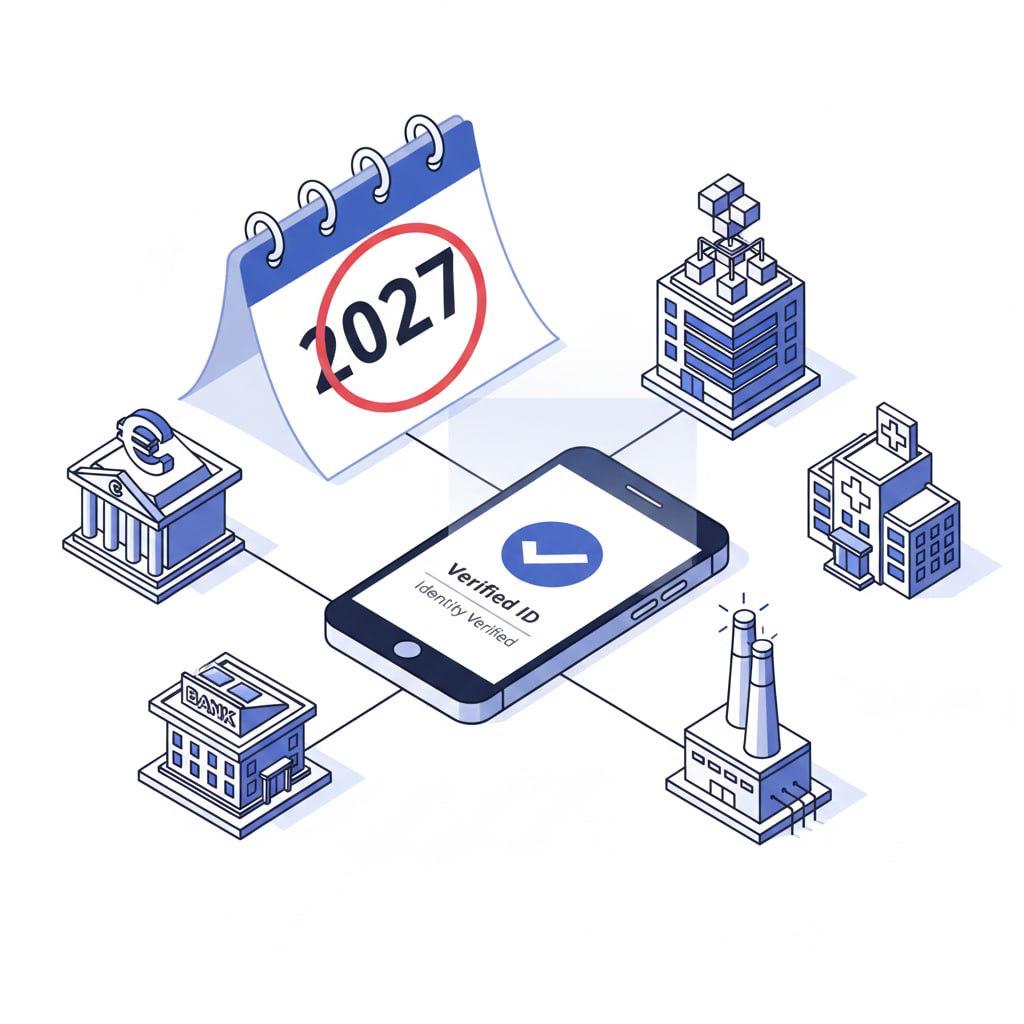
The EUDI Mandate: A Market-Wide Challenge
By late 2027, under the amended eIDAS Regulation, private companies in key sectors—
including banking, financial services, and crypto platforms—will be legally
required to
accept the EU Digital Identity EUDI Wallet for strong user
authentication and the
presentation of verified identity data (identification and verification). Furthermore, under
the new Anti-Money Laundering (AML) Regulation, these institutions are explicitly
authorized to use the EUDI Wallet to fulfill their strict customer identity verification (KYC)
obligations.
1. The Obligation to Accept the Wallet
Regulation:
Regulation EU 2024/1183 (amending Regulation EU No 910/2014) also
known as eIDAS 2.0
• Who must accept it?
Private "relying parties" providing services in specific sectors where
"strong user
authentication" is required by law or contract. This includes banking, financial services,
transport, energy, social security, health, drinking water, postal services, digital
infrastructure, education, and telecommunications. Exemptions: Microenterprises and
small enterprises.
• The Deadline
These entities must accept the wallet no later than 36 months after the
entry into force
of the implementing acts. This places the effective deadline around late 2027.
• Source: (Article 5f(2) of Regulation
(EU) 2024/1183)
2. Using the Wallet for Customer Verification (KYC/AML)
Regulation:
Regulation EU 2024/1624 (Anti-Money Laundering Regulation)
• Can it be used for verification?
Yes. The new AML Regulation explicitly permits "obliged entities" (banks,
crypto-asset
service providers, etc.) to use electronic identification means compliant with the eIDAS
Regulation (which includes the EUDI Wallet) to verify a customer's identity.
• Why this matters?
It provides the legal certainty that using the EUDI Wallet satisfies the
strict "Customer
Due Diligence" (CDD) requirements necessary to prevent money laundering.
• Source: (Article 226)(b) of Regulation
(EU) 2024/1624
Problem: Technical and Legal Hurdles
The Core Problem for Businesses (Relying Parties: banks, crypto exchanges etc.):
The process of direct integration is complex and fragmented, involving strict technical and
legal procedures. Each Relying Party (RP) must:
1. Individually integrate with multiple,
disparate EUDI Wallet implementations and
protocols. This requires supporting:
• OpenID4VC/OpenID4VP - The current
standard for online verifiable presentations
• Digital Credentials API - The emerging
W3C standard for browser-mediated flows
• Multiple trust anchors - Each Wallet
Provider uses unique EAA (Electronic
Attestation of Attributes) Certificates, requiring validation against periodically
updated Trusted Lists from 27 EU Member States
2. Obtain a specialized certificate as
per
Implementing Regulation EU 2025/848.
This presents a significant technical, legal, and operational hurdle with a hard deadline.
Solution: QuickGate (EUDI Wallet Gateway)
QuickGate is a EUDI Wallet Gateway designed to simplify and accelerate compliance
for
Relying Parties. We're doing for EUDI compliance what Stripe did for payments.
How It Works:
QuickGate acts as an Intermediary on behalf of your business. As defined in the EUDI
Wallet
Architecture (Section 3.11.3), an
Intermediary is a special class of Relying Party that
acts for others.
• Compliance by Proxy & No Certificate
Hassle: We manage all the complex legal and
technical registration with EU trust registries on your behalf. You operate under our
compliance umbrella, eliminating the need for you to obtain and manage
your own
specialized Relying Party Certificates. The operational contract between us serves as
the legal basis for this, allowing you to leverage our status as a compliant Relying Party.
• Single Integration: Your platform
integrates once with QuickGate's unified API (instead
of integrating all EUDI wallets).
• Wallet Agnostic: We handle the
complexity of connecting to all various EUDI Wallets.
• Security by Design: QuickGate is built
with security at its core, leveraging a zero-trust
architecture and the expertise of software engineers experienced in high-security
systems. This ensures end-to-end protection for all data in transit and compliance
operations.
• Data Relay & Minimization: We request
the necessary user attributes from the wallet
and forward them securely to your system. In strict adherence with Section 3.11.3, we
do not store any data related to the content of the transaction.
• Audit Log Integrity: QuickGate
provides zero-PII, cryptographically anchored audit
logs, ensuring legal non-repudiation without storing user data. Each verification
generates a hash-only entry in a Merkle-based transparency log, while raw attributes
remain only with the client as an encrypted evidence blob.
• Key Legal & Operational Assurance: The
European Digital Identity Regulation (Art.
5b(10)) states: "Intermediaries acting on behalf of relying parties shall
be deemed to
be relying parties."
Legal Problem Details: The Certification Burden
For any company to accept the EUDI Wallet directly, they must undergo a complex and
costly certification process as a Relying Party:
1. Obtain a Relying Party Access Certificate
(RPAC): This requires formal registration
with a National Registrar in an EU Member State, involving a detailed assessment of
their technical and organizational security measures. This registration process is further
detailed in
Commission Implementing Regulation EU 2025/848 , which establishes
the
specific rules for registering wallet-relying parties across all Member States
2. Demonstrate High-Level Security & GDPR
Compliance: The registration process is
"proportionate-to-risk," meaning companies must provide evidence of robust security
and data protection practices. This is demonstrated through internationally recognized
certifications, primarily:
• ISO/IEC 27001 for Information Security
Management - necessary to validate
adherence to
Regulation (EU) 2024/1183 Recital 12 (security by design) and pass
the "proportionate-to-risk" assessment required by Article 5b(2).
• ISO/IEC 27701 for Privacy Information
Management (extending GDPR compliance)- required to fulfill
Regulation EU 2024/1183 Article 5a(17) of , which explicitly
states that "Compliance of such processing with Regulation (EU) 2016/679 (GDPR)
shall be demonstrated"
This presents a significant barrier: each company must individually navigate a legal and
technical certification landscape, a process that is time-consuming, expensive, and
requires specialized expertise.
Legal Solution: Compliance by Proxy
QuickGate eliminates this entire burden by acting as your Intermediary Relying
Party.
How it works:
1. We Hold the Certificates: QuickGate
undergoes the rigorous certification process once
to obtain our own RPAC and the necessary Relying Party Registration Certificates
(RPRC) on behalf of our clients.
2. You Operate Under Our Compliance
Umbrella: Your company leverages our certified
status. You are not required to obtain your own RPAC or the associated ISO
certifications.
3. The Legal Foundation is a Contract:
The operational service contract between your
company and QuickGate serves as the legal basis for this relationship, explicitly
authorizing us to act on your behalf. This is fully compliant with the EUDI Wallet
Architecture Framework.
Reference:
Annex-2, RPI_04
Result: You achieve full legal compliance with the eIDAS mandate through a simple
commercial agreement, bypassing a multi-year, high-cost certification journey.
How We Ensure Compliance: Our Trust Framework
As a certified Intermediary Relying Party, QuickGate is built on the principle that trust is the
foundation of digital identity. We are committed to upholding the highest standards to
protect the ecosystem, our clients, and end-users.
1. Governance & Compliance Framework
We operate under a "Security-by-Design" model, strictly adhering to:
• eIDAS 2.0 Regulation: Ensuring full
compliance with the European Digital Identity
Architecture and Reference Framework (ARF).
• GDPR: Acting as a compliant Data
Processor, enforcing principles of data minimization
and purpose limitation in every transaction.
2. Certification & Assurance
To validate our integrity to regulators and stakeholders, we maintain a certified Integrated
Management System:
• ISO/IEC 27001 (Information Security):
Implements rigorous controls for confidentiality,
integrity, and availability, strict access controls, and vulnerability management.
• ISO/IEC 27701 (Privacy Management):
Extends our security controls to formally
demonstrate our compliance with GDPR requirements for processing personal data.
3. Operational Commitments
• Strict Data Minimization: We forward
only the user attributes you request and the user
consents to. We do not store any personally identifiable information PII from the
transaction.
• Cryptographically Enforced
Confidentiality: Data transmitted between the client and
QuickGate is protected by end-to-end encryption at the
application level. This ensures
that no intermediary—including our own infrastructure—can access the data payload,
strictly enforcing our Zero-Trust and Zero-Persistence commitments.
• Audit Log Integrity: We provide
zero-PII, cryptographically anchored audit logs to
ensure legal non-repudiation for all verification transactions.
While the transparency
log (Merkle-based) provides proof of verification, the raw attributes are secured by the
client within an encrypted evidence blob, completing the legal
chain of custody
without compromising user privacy.
• Continuous Auditing: We undergo
regular third-party audits to maintain our
certifications and ensure ongoing alignment with evolving ETSI standards and
regulatory requirements.
Technical Problem Details: Hurdles for EUDI Wallet
Integration
To comply with the EUDI mandate, businesses face a set of distinct technical requirements:
• Front-End Integration across All
Platforms:
Relying Parties need client-side integrations (with EUDI Wallet) for web,
mobile,
desktop, and physical proximity scenarios. This includes supporting strong user
authentication flows, both online and in-person, with seamless user experience.
• Mandatory Support for OpenID4VP and Digital
Credentials API:
Direct integration with the OpenID4VP
protocol remains essential, as it's the currently
mandated standard throughout the
EUDI reference architecture for requesting and
sharing Verifiable Presentations online.
However, the strategic direction for remote flows
is the Digital Credentials API
("Cred_API") as described in
Topic F (section OIA_08). This API offers secure
credential
issuance, access, and presentation, and addresses both same-device and cross-device
user flows. its currently being standardized through the Digital Credentials API by W3C.
• Unlike direct integration using custom schemes (e.g. mdoc-openid4vp://
), which
are interim and raise security issues, Cred_API enables
browser-mediated flows,
supporting proximity and remote use cases.
• The EUDI ecosystem is actively working towards adoption of Digital
Credentials
API for long-term interoperability.
• SDKs and integrations must support OpenID4VP
for immediate compliance, while
also preparing for upcoming requirements and greater reliability via Digital
Credentials API.
• Verification of Credentials from All EU Member
States:
Identity verification requires validating cryptographic attestations from
multiple EUDI
Wallet providers. Each provider’s certificates must be checked against the trusted lists
issued by 27 EU Member States.
• The solution must support signature verification for formats such as
SD-JWT
(Selective Disclosure JWT) and mdoc (CBOR/COSE).
• Real-time revocation checks (OCSP/CRL) are also necessary.
• Monitoring & Analytics (Optional, but
Valuable):
To improve operational reliability, businesses benefit from monitoring
tools that track
verification success rates, failure reasons, and process metrics across platforms and
wallet providers.
Non-Functional Requirements:
• Security best practices: Protocols must be implemented according to
regulatory
standards (EUDI, eIDAS) and only use certified libraries/APIs;
data confidentiality and
integrity are non-negotiable.
• Mandatory Non-Repudiation Audit Trail:
The solution must deliver a
cryptographically-anchored audit trail to ensure legal non-repudiation for all
transactions, while simultaneously upholding the Zero-Persistence
principle of never
storing user PII.
Bottom line:
Complying with EUDI Wallet requirements means supporting secure, standards-based
integrations for OpenID4VP and Digital
Credentials API across relevant platforms, robust
certificate verification workflows, and optional monitoring tools.
Technical Solution: EUDI Wallet Gateway with Complete Ecosystem
"We're doing for EUDI compliance what Stripe/PayPal did for payments" - Turning
complex
regulatory infrastructure into simple API calls.
Essential Components
1. Gateway Core
• API Layer: Unified REST API for all
wallet integrations
• Session Management: Handles
verification flows & state
• Trust & Validation: Service Manages
wallet provider certificates & validation
• Protocol Engines: Built-in support for
the mandated OpenID4VP protocol and
readiness for the future Digital Credentials API (DC API).
2. SDK Suite
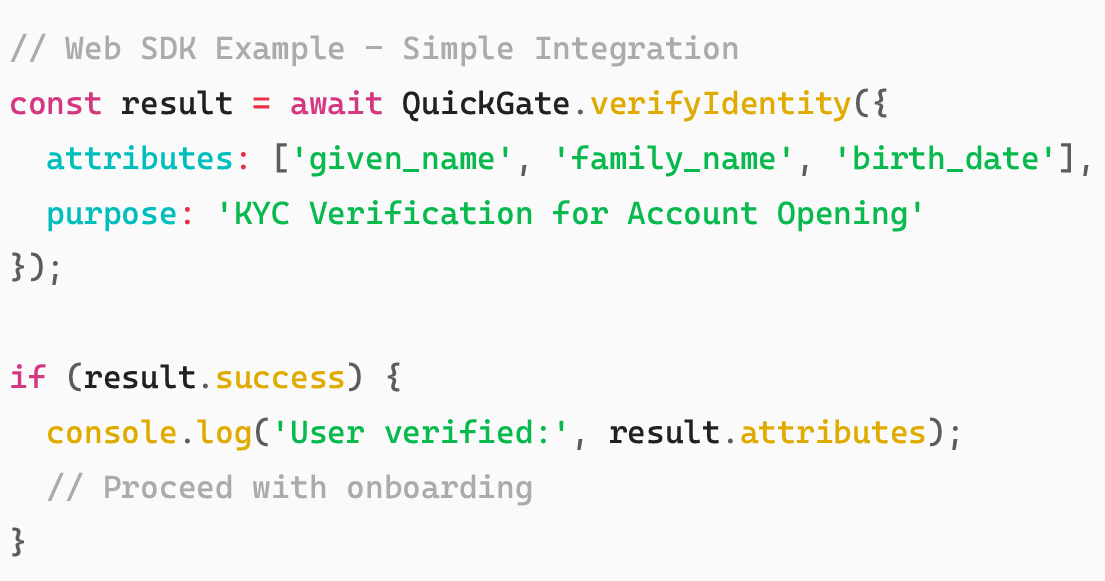
We provide SDK for all major platforms, making integration a matter of a few lines of code
Platforms: Web, Node.js, Java, Python, React Native, Flutter, iOS, Android
Server SDKs: Tools for secure webhook handling, session creation, and backend
integration.
3. Admin Dashboard
• Client management & API keys
• Real-time verification monitoring
• Analytics & success rate tracking
• Usage metrics & billing
4. Developer Tools
• Comprehensive Docs: API reference,
quick start guides
• Sandbox Environment: Test with mock
wallets
• Zero-Trust Architecture: We use
application-layer encryption for data exchange
between the client's system and the QuickGate API, providing defense-in-depth. This
guarantees that even internal infrastructure (proxies, load balancers, etc.) cannot view
the data payload, reinforcing the Zero-Trust and Zero-Persistence architecture.
• Data Minimization: No storage of user
PII
• Audit Log Integrity: QuickGate
provides zero-PII, cryptographically anchored audit
logs, ensuring legal non-repudiation without storing user data. Each verification
generates a hash-only entry in a Merkle-based transparency log, while raw attributes
remain only with the client as an encrypted evidence blob. This delivers full auditability
for regulators while preserving strict data minimization.
Bottom Line: Complete platform that turns EUDI compliance from a complex regulatory
and
technical burden into a simple API call.
Our Go-To-Market Advantage & Strategic Position
While the market waits for official government wallets and certification bodies to become
active, QuickGate is building now. Leveraging deep expertise in
security-focused
software engineering, our team is designing a solution that is ahead of the market and
built
with security at its core.
Building Ahead of the Market
1. Proactive Development: The reference
wallet—which each EU state will use to build
their own wallets—and the
OpenID4VP protocol (used by the EUDI Wallet for requesting
and presenting credentials) implementation are open source. We are using them to pre-build our
entire backend, SDKs, and integration layers, bypassing the current
certification deadlock.
2. First-Mover in an Empty Market: The
market for such gateway solutions is virtually
empty. Only two potential competitors (Verimi and Namirial) exist, with Verimi’s solution
not expected until late 2026 and no clear information accessible for Namirial’s
production state.
3. Clear Business Model: We are
initiating conversations with Relying Parties to sign pre-commitment agreements for a product that
will be market-ready well before the
2026/2027 deadline.
Deep Technical Expertise & Secure Architecture Foundation
Beyond regulatory and protocol alignment, QuickGate is being developed by a team of
security software engineers with a proven track record in high-security systems —
including Zero-Trust cloud infrastructure, true end-to-end encrypted communication
systems, cryptography and blockchain related software solutions. This allows us not only to
integrate the EUDI framework but also to implement it with real cryptographic rigor instead
of “checkbox” compliance. We don’t treat security as compliance decoration — it’s our
architectural substrate.
Call to Action for Relying Parties
The 2027 deadline is approaching. Instead of facing a last-minute, costly, and complex
integration scramble, partner with QuickGate for a secure, simple, and compliant solution.
Motto: We're doing for EUDI compliance what Stripe did for payments
QuickGate Business Model: Usage-Based (Pay-As-You-Go)
The QuickGate revenue model is designed for simplicity, transparency, and scalability,
aligning the client's cost directly with the business value received.
Key Revenue Driver: Transaction Volume (Cost Per API Request)
QuickGate operates on a Usage-Based Pricing (Pay-As-You-Go) model, ensuring that
clients only pay when they successfully receive value from the service.
| Component |
Description |
| Pricing Unit |
Cost per API Request |
| Billing Event |
A cost is incurred every time the client's system successfully
calls the
QuickGate gateway to authenticate, verify, or identify an end-user.
|
How Billing Works
The pricing structure mirrors the highly successful models of modern API providers (like
Stripe), prioritizing a low barrier to entry and scaling naturally with the client's success.
1. Cost Incurrence (Real-Time Metering): Every successful transaction
instantly incurs a
financial cost on the client's account, which is recorded by QuickGate's internal
monitoring system.
2. Monthly Billing: All individual incurred costs are automatically
tracked and aggregated
over the monthly billing cycle. The client receives a single, unified monthly invoice
detailing the total volume of transactions and the final amount due.
This model is critical for the "land and expand" strategy, minimizing the client's upfront
commitment while ensuring QuickGate's revenue grows automatically as the client
increases their user base and transaction volume.